2 Watercolor Fighter Jet Clipart Bundle
A Designer’s First Look: Loose, Lively, and Unexpectedly Versatile
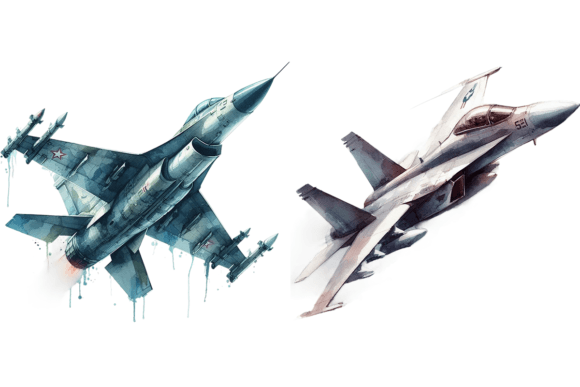
When I opened the 2 Watercolor Fighter Jet Clipart Bundle, I wasn’t expecting charm—but that’s exactly what hit me first. These aren’t rigid military schematics or hyper-realistic vector renderings. They’re soft-edged, painterly jets—like someone sketched them mid-flight with a slightly damp brush. One leans forward with subtle motion blur; the other tilts upward, wings angled with quiet confidence. The watercolor texture breathes. It’s imperfect, expressive, and refreshingly human in a category often dominated by sharp, sterile icons. That looseness is its strength—and its first real test for embroidery.
Real-World Use Case: A Custom Embroidered Tote for an Aviation-Themed Baby Shower
Last week, I prepped a small-batch order of canvas tote bags for a client celebrating her pilot husband’s upcoming paternity leave. She wanted something joyful—not intimidating—something that whispered “aviation” without shouting “combat.” The 2 Watercolor Fighter Jet Clipart Bundle landed perfectly there. I resized one jet to fit a 4-inch hoop, placed it just above the bottom seam on natural canvas, and stitched it as a fill-and-satin combo with light gray and sky-blue threads. The result? A design that felt handmade, warm, and intentional—not like a stock graphic dropped in. Customers commented on how “surprisingly sweet” it looked. That’s the power of watercolor reinterpretation: it disarms the subject and invites connection.
Where This Bundle Shines (and Where It Asks for Thought)
The 2 Watercolor Fighter Jet Clipart Bundle excels in projects where mood matters more than precision: baby embroidery on organic cotton onesies, holiday embroidery on linen tea towels, boutique aprons for aviation-themed cafés, or personalized sweatshirt patches for teen pilots-in-training. Its soft edges translate beautifully into low-density fill stitches and gentle satin outlines—no harsh pixelation, no overworked corners. As Illustrations, they’re built for adaptation, not replication.
But—and this is critical—watercolor softness doesn’t automatically mean embroidery ease. On stretchy fabric like cotton jersey or thin knits, those delicate wingtips and tail fins need extra stabilizer support and possibly reduced stitch density to avoid puckering. On dark fabric, the subtle gradients may vanish unless you adjust thread contrast deliberately—try a warm charcoal fill with a crisp white outline to lift the shape. And on curved surfaces like caps? Stick to the simpler of the two jets, and avoid placing it near the bill seam where distortion is inevitable.
What This Means for Your Craft Business & Customer Trust
For Etsy sellers and small shop owners, the 2 Watercolor Fighter Jet Clipart Bundle offers quiet differentiation. In a sea of generic airplane clipart, this bundle feels curated—not commodified. When customers see that hand-painted quality translated into clean, confident stitching on a finished product, it elevates perceived value. It tells them: *This wasn’t rushed. This was chosen.* That builds trust, especially for personalized gifts and nursery decor, where emotional resonance matters more than technical flash.
That said, don’t assume automatic scalability. At 3600 x 3600 pixels and 300 DPI, these are high-res Graphics—ideal for print mockups, digital previews, or large-format applique designs—but they’re not embroidery files out of the box. You’ll need to digitize them thoughtfully. A dense fill stitch across the entire jet body may overwhelm lightweight fabric; consider breaking it into layered elements (fusible applique base + embroidered details) for breathability and texture.
Practical Designer Notes Before You Stitch
- Always test on scrap fabric first—especially if using textured weaves or blends. Watercolor edges can blur further under dense stitching.
- Check thread color contrast early. Soft grays and muted blues work beautifully, but avoid low-contrast combos on dark backgrounds unless you add a subtle outline stitch.
- Review stitch density in your digitizing software. Let the watercolor spirit guide you: lighter fills, open satin lines, and strategic running-stitch accents preserve the original’s airiness.
- Confirm hoop size compatibility. These scale well down to ~3 inches, but below that, fine details (like cockpit windows or engine lines) may collapse—simplify or omit them intentionally.
- Inspect small details at actual stitch size. Zoom in on your embroidery preview. Does the tail fin read clearly? Does the wing taper convincingly? If not, adjust spacing—not just scaling.
- Test black-and-white mockups. Many buyers visualize embroidery in monochrome first. Does the shape hold up without color cues?
- Compare light vs. dark fabric backgrounds in your design software. The transparency in the PNGs gives you flexibility—but only if your digitizing honors the original’s tonal balance.
- Use proper cutaway or tear-away stabilizer, especially for structured items like patches or tote bags. Watercolor shapes rely on clean edges—stabilizer keeps them honest.
- Verify licensing before commercial use. Since the bundle delivers PNGs only, confirm whether redistribution or resale of finished embroidered goods is permitted under the creator’s terms.
Final Thought: Not Just a Jet—A Mood, A Moment, A Made-With-Care Detail
The 2 Watercolor Fighter Jet Clipart Bundle won’t replace your go-to technical aircraft vector for aviation school merch—but it fills a space many designers overlook: the space between concept and comfort. It’s for the maker who understands that a fighter jet, rendered with tenderness and texture, becomes something else entirely: a symbol of aspiration, adventure, or quiet pride. Whether stitched onto a baby’s onesie, printed on a craft fair banner, or digitized into a limited-run embroidered patch, it carries intention. And in handmade product culture—where authenticity is currency—that intention is everything.